Don't miss the latest SALE - All Digital Downloads $9.99!

The Law, the Prophets, and the Waiting
Lex data est, spes servata est.
The law was given, hope was preserved.
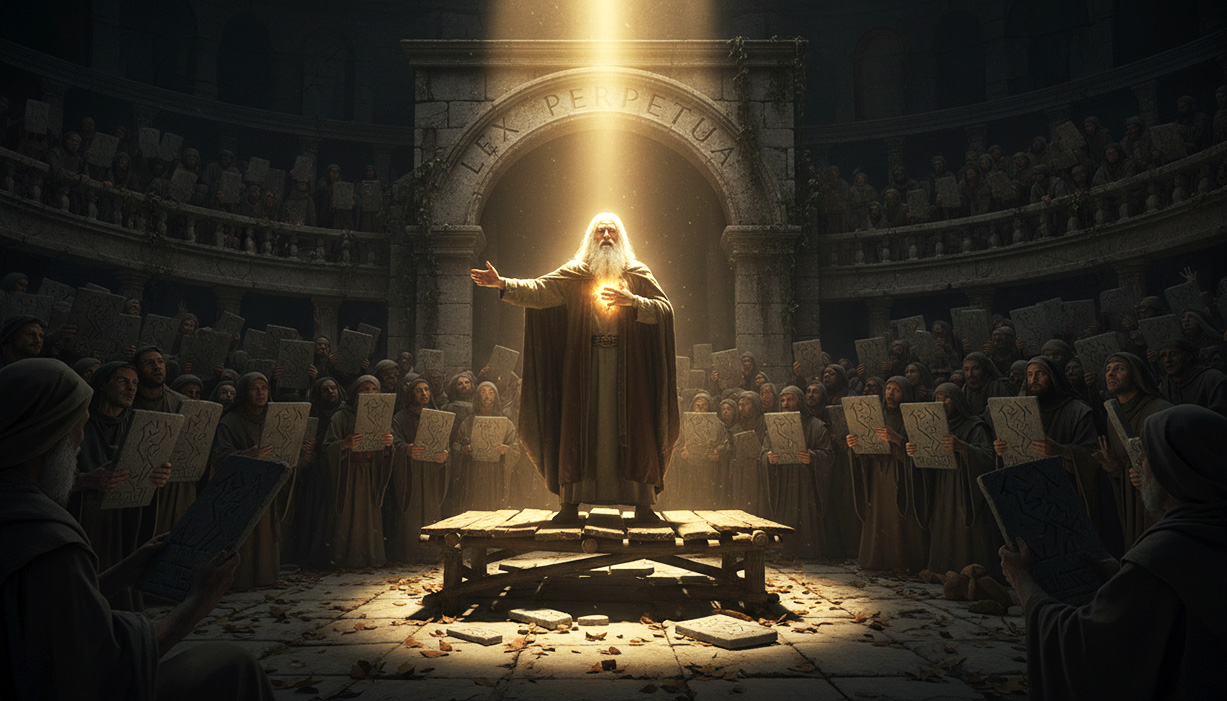
As the covenant unfolds, God’s guidance takes shape not only in promises, but in structure. The Law enters history not as a burden meant to restrain life, but as a form meant to protect it. After wandering, after fear, after confusion, boundaries are given so that freedom does not dissolve into chaos.
Ego sum Dominus Deus tuus.
I am the Lord your God.
(Exodus 20:2)
The Law begins not with command, but with identity. Before instruction comes relationship. Before expectation, belonging. Israel is reminded who God is before being told how to live. Obedience is framed as response, not as transaction.
The commandments do not attempt to explain everything. They draw lines around what matters most: reverence, justice, rest, truth, care for neighbor. They shape a people capable of living together without forgetting God.
Yet the Law alone does not complete the story.
Humanity struggles to hold it fully. Memory fades. Power corrupts. Ritual replaces intention. The covenant is kept on the lips, but sometimes lost in the heart. Scripture does not hide this tension. It records it faithfully.
So God sends voices.
Prophets rise not as comforters, but as interrupters. They speak when silence becomes dangerous. They remind the people that the covenant is not merely written on stone, but meant to live within conscience.
Convertimini ad me in toto corde vestro.
Return to me with all your heart.
(Joel 2:12)
The prophets do not introduce a new God. They recall the same One who spoke at creation, who walked in the garden, who formed covenant on the mountain. Their words cut, but they also heal. Judgment is spoken not to end the relationship, but to rescue it.
Again and again, the message is clear: sacrifice without justice is empty, worship without mercy is noise, faith without care for the vulnerable is incomplete.
Yet even the prophets point beyond themselves.
They speak of a future that does not arrive quickly. A restoration not yet visible. A peace still deferred. The people learn to wait.
Waiting becomes a spiritual discipline. Not passive resignation, but faithful endurance. The promise has not failed, but it has not yet arrived.
Populus qui ambulabat in tenebris vidit lucem magnam.
The people who walked in darkness have seen a great light.
(Isaiah 9:2)
This light is named before it is seen. Hope is spoken into absence. The covenant stretches forward, carried by expectation.
By the end of this long season, humanity stands formed by Law, awakened by prophecy, and shaped by longing. The question is no longer whether God will act, but how.
The silence that follows is not abandonment. It is anticipation.
The road has been prepared.
The promise is still alive.
And the waiting itself has meaning.