Don't miss the latest SALE - All Digital Downloads $9.99!

In the Beginning, and the Quiet That Followed
In principio creavit Deus caelum et terram.
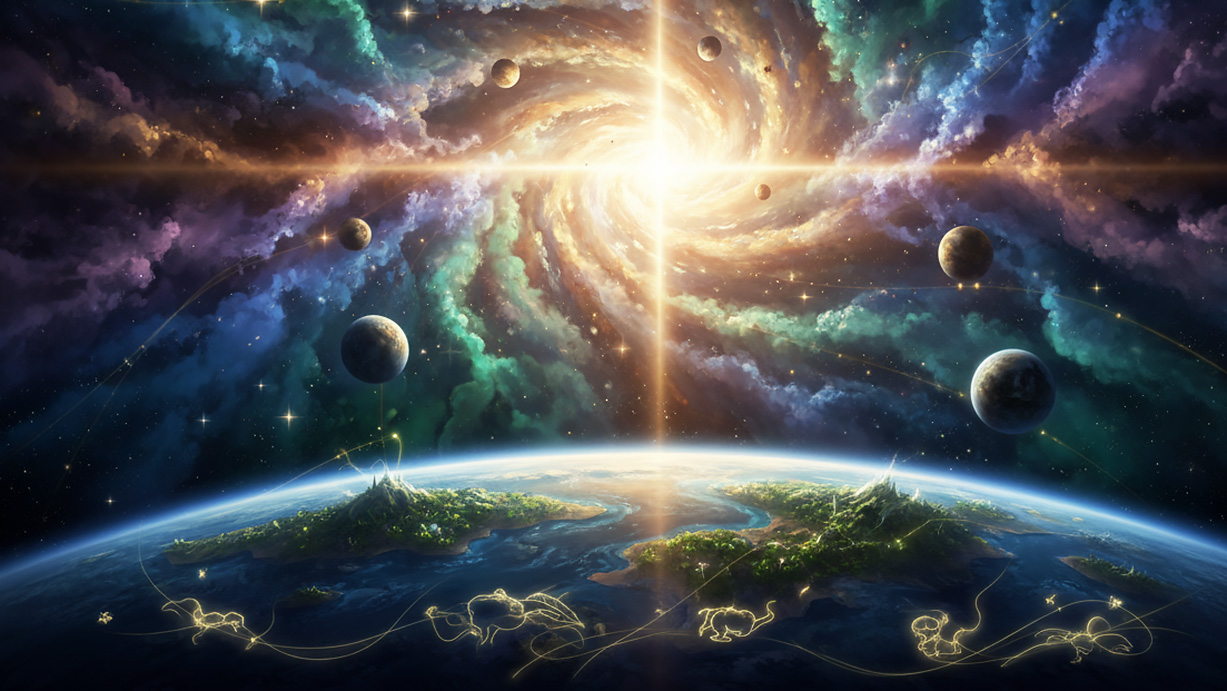
“In the beginning, God created the heavens and the earth.”
Genesis opens not with an argument, but with a declaration. No defense is offered, no explanation demanded. Creation is presented as a given, a reality that precedes all questions. Before time is measured, before names are assigned, before humanity appears, there is intention. There is order. There is meaning.
“In principio creavit Deus caelum et terram.“
In the beginning God created the heavens and the earth.
(Genesis 1:1)
The earth, we are told, was formless and empty, and darkness covered the deep. This is not merely a description of the physical world at its earliest moment. It is also a mirror held up to every beginning that feels uncertain. Scripture does not deny chaos. It names it. Yet it does not leave it untouched.
“Terra autem erat inanis et vacua, et tenebrae erant super faciem abyssi.“
Now the earth was formless and empty, and darkness was over the surface of the deep.
(Genesis 1:2)
“And God said, ‘Let there be light.”
“Dixitque Deus: Fiat lux.“
And God said, “Let there be light.”
(Genesis 1:3)
Light is the first act of creation, not as ornament, but as orientation. Before land, before life, before purpose is assigned, light enters. It separates. It reveals. It makes seeing possible. In this sense, light is not only physical illumination, but the condition for understanding. Faith begins here, not with answers, but with visibility.
As the days unfold, Genesis moves with rhythm rather than haste. Separation follows separation. Light from darkness. Waters above from waters below. Sea from land. Each act is deliberate. Creation is not rushed. It is spoken into being, then observed.
“Viditque Deus quod esset bonum.“
And God saw that it was good.
(Genesis 1)
The Creator pauses to acknowledge what has been made.
This repeated recognition matters. Goodness is not declared at the end only. It is affirmed along the way. Scripture teaches us that value is present even before completion. Becoming does not cancel worth.
When life emerges, plants bearing seed, creatures of sea and sky, animals of the land, creation becomes generous. It multiplies. It participates. God does not hoard creativity but shares it, embedding fruitfulness into the fabric of the world.
“Germinet terra herbam virentem et facientem semen.“
Let the earth bring forth vegetation, plants yielding seed.
(Genesis 1:11)
Then comes humanity.
“Let us make mankind in our image, in our likeness.”
“Faciamus hominem ad imaginem et similitudinem nostram.“
Let us make mankind in our image, after our likeness.
(Genesis 1:26)
This statement is brief, but its weight is immeasurable. Humanity is not introduced as an afterthought, nor as a ruler detached from responsibility. To bear God’s image is not to dominate without care, but to reflect His nature within creation. Stewardship follows identity, not the other way around.
Human beings are placed into a world already called good. They are not tasked with fixing a failure, but with tending a gift. Work enters Scripture not as punishment, but as participation. To cultivate, to name, to care is to continue the rhythm begun in creation itself.
Genesis 1 ends not with exhaustion, but with completion. God sees all that He has made, and it is very good.
“Vidit Deus cuncta quae fecerat, et erant valde bona.“
God saw all that He had made, and it was very good.
(Genesis 1:31)
Rest follows, not because creation is fragile, but because it is whole. Rest becomes sacred time, reminding us that meaning is not found only in motion.
For readers today, Genesis does not demand that we abandon inquiry or silence curiosity. Instead, it offers a foundation. It tells us that before complexity, there was order. Before division, intention. Before fear, light.
The beginning described in Genesis is not locked in the past. It repeats itself whenever light enters confusion, whenever order rises from chaos, whenever care replaces indifference. Creation, in this sense, is not finished. It continues wherever humanity chooses to reflect the image it was given.