Don't miss the latest SALE - All Digital Downloads $9.99!


The Fracture and the Promise
Vocavit Dominus Deus hominem et dixit ei: Ubi es?
The Lord God called to the man and said, “Where are you?”
The fracture does not arrive with thunder. It enters quietly, almost unnoticed, through a question. Not a command, not a denial, but a subtle shift in attention. Genesis shows us that separation often begins not with rebellion, but with doubt about what has already been given.
The garden is still present. The trees still bear fruit. Nothing outward has changed. And yet something essential has begun to move. Trust gives way to curiosity that seeks control. Relationship bends toward self-definition. The first fracture appears not in action, but in listening.
Scripture does not portray the fall as ignorance, but as misplaced desire. The longing is not for evil, but for autonomy without dependence. To know apart from God. To choose without listening. In this moment, humanity does not reject creation, but attempts to stand at its center.
The result is not immediate destruction. It is distance.
Aperti sunt oculi amborum.
The eyes of both were opened.
(Genesis 3:7)
Awareness enters, but not as clarity. It arrives as exposure. Shame follows where trust once lived. The human story shifts from walking openly to hiding carefully. The garden remains, but communion is fractured.
God’s response is not abandonment. It is presence.
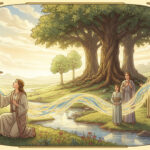
Vocavit Dominus Deus hominem et dixit ei: Ubi es?
The Lord God called to the man and said, “Where are you?”
(Genesis 3:9)
The question is not asked because God lacks knowledge. It is asked because humanity has lost direction. The voice that once called creation into being now calls the human heart back into relationship.
Consequences follow, but they are not the final word. The ground resists. Work becomes heavy. Relationships strain. The world absorbs the fracture it has been given. And yet, even here, mercy moves quietly beneath judgment.
God covers what has been exposed.
Fecit quoque Dominus Deus Adae et uxori eius tunicas pelliceas et induit eos.
The Lord God made garments of skin for Adam and his wife and clothed them.
(Genesis 3:21)
Care appears where shame could have remained final. Even in separation, provision continues.
Then comes the promise.
It is spoken without spectacle, woven into consequence rather than announced as victory. The future will carry struggle, but it will also carry hope. What has been fractured will not remain untouched by grace.
Ipsa conteret caput tuum.
She shall crush your head.
(Genesis 3:15)
This is not the end of the story, but the seed of its continuation. Scripture places promise early, almost insisting that failure never stands alone. Even at the moment of loss, restoration is already being spoken.
Humanity leaves the garden, but God does not leave humanity.
Eiecit Adam.
He sent Adam forth.
(Genesis 3:23)
The path forward is harder, but it is not empty. History begins not as punishment alone, but as possibility shaped by mercy.
The fracture explains the world as we know it. The promise explains why it has not ended.
Every generation lives within this tension. We inherit both the wound and the hope. We experience distance, yet we are still called. We fail, yet we are still sought.
Genesis does not move from perfection to ruin and stop there. It moves from creation to fracture toward redemption. The promise does not erase responsibility, but it reorients it.
To live faithfully after the fracture is not to pretend the garden never mattered, nor to despair that it was lost. It is to carry forward the memory of communion and the trust that restoration remains possible.
The story moves forward, not because humanity is strong enough, but because God remains faithful enough to continue speaking.